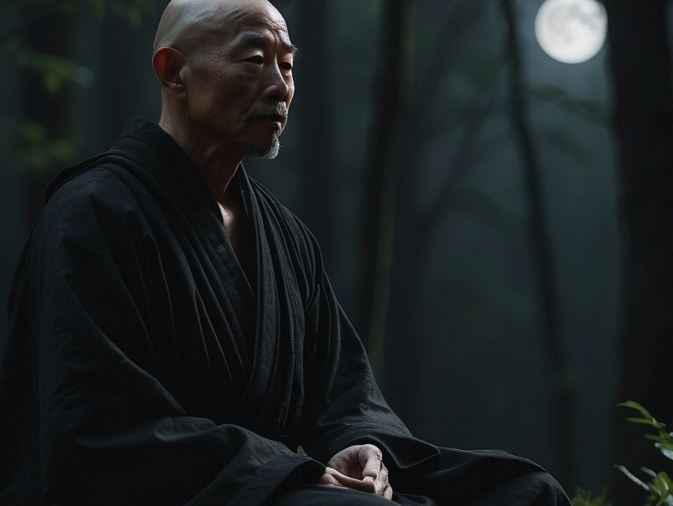
Becoming Buddhist
Jukai Ceremony formaly becoming buddhist. The ceremony of Jukai in the sangha. It is the primary initiation ceremony of zen. Its when your formally take up the way of Zen. The True inner initiation of zen is enlightenment, but meanwhile we do outer initiation ceremonies like Jukai, which have a deep meaning. The terms vary based on buddist group, so these terms are various terms that might be used in zen or other buddhist associations. - so try not to worry to much about them. For those who don't know, jukai is the traditional Buddhist ceremony of receiving the precepts. There are three formal levels of participation in Zen. From the top down, they are: 1.Zen Master Dai-oshō After having become oshō one may become a dai-oshō, resident priest in a Zen-temple 2.Zen Priest 3. A member of a Zen community who has received "lay ordination". "Lay ordination" is approximately the equivalent of confirmation in a Christian community. "The precepts are not rules. They are the commonway of life for Buddhists." Furthermore, the Buddhist precepts apply only to yourself. They are never, ever, ever to be used as a means of judging other people's behavior. Laity The term ‘laity’ refers to lay or non-ordained Buddhist practitioners who are not part of the monastic order. In the Buddhist tradition, the laity are sometimes referred to as upāsaka (for men) and upāsika (for women). This refers to people who are not monks, nuns or novice monastics, yet undertake certain vows (usually in the form of taking refuge in the Triple Gem and attempting to live according to particular moral precepts and the Eightfold Path). A person publicly vows to honor the Three Devotions, and uphold the Three Universal Precepts and the Ten Fundamental Precepts. The Three Devotions are to Buddha, Dharma (Buddhist teachings) and Sangha (Buddhist community). The Three Universal Precepts are 1) to observe social rules, 2) observe the universal rules of morality and 3) work for the salvation of all beings. The Ten Fundamental Precepts are 1 not to destroy lie 2 not to steal 3. not to have excessive desires 4. not to lie 5. not to live by selling harmful things 6. not to discuss the failures of Buddhist priests and laypeople 7. not to praise oneself or berate others 8. not to begrudge the sharing of Buddhist teachings or other things but give them freely 9 not to become angry and 10 not to abuse the three treasures; Buddha, Dharma and Sangha. In Jukai you receive the rakasu, which represents the robe of the Buddha, and your connection to all the ancient lineage of people who have walked the Way and suffered for wisdom and also gained wisdom. You share in their light and their effort. You take on a Buddhist name, identifying yourself in the tradition in that way. You engage with the precepts of the Bodhisattva. There are sixteen of them. Pretty much they are common sense undertakings. "I take up the way of not killing," "not stealing," "not lying," "not undertaking sexual misconduct," "not misusing drugs." Things like that, simple things. "Not indulging in anger," "not praising myself while abusing others." And as well as that there is taking refuge as part of the precepts. "I take refuge in the Buddha." "I take refuge in the dharma." "I take refuge in the sangha." Which is the primary act, I suppose, really. To say that I trust that there is a Way and I commit myself to it. Jukai is more personal than anything else only you make the decision to live this way of life , to seek enlightenment.
























































































































123 Portobello Road England GB 98765
© T. H. E. HOTEL